
Cheese Making in Kriss Guptill's 5th Grade Classroom
Yes, that is right, learning can be fun as well as tasty.
Ever hear of 5th graders making canolies with homemade mascarpone cheese? How about 5th graders stretching mozzarella and stirring ricotta made from scratch for lasagna? These same fifth graders also made savory pretzel dips as a snack for open house with fromage blanc made in the classroom. The fifth graders in Mrs. Guptill's room did all this with funds from a grant supplied by the Central New York Teaching Center. This year Science and Social Studies were twisted together in a fun and meaningful way. In this grade, the history of the United States is studied, most of which occurred before refrigeration. A key component of life for the population was how to store food without it going bad. Cheese-making was the method that was used to preserve the nutrients in milk. Because the United States is so culturally diverse, many different ethnic cheeses were made here.
In Science, students study chemistry and chemical reactions. Cheese-making in the classroom bridges these two areas. Students have witnessed first hand that milk is a suspension of many different compounds and that these compounds can be separated with heat and acid. Bacteria growth, culturing, and pasteurization have also been explored.
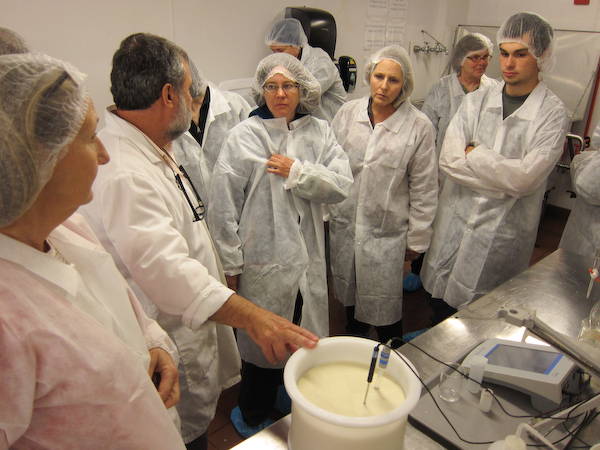
First they pour out the milk, add citric acid and rennet and wait for the curd to set.
When the curd has formed cutting begins. Of course everyone gets a turn.
once the curd ids broken up, It is transferred to another container.
Then the whey is poured off until it is dry enough for the final heating.
It is then heated in a bowl of hot water, until it begins to stretch.
After a few minutes it really stretches nicely and can be formed into lots of cool shapes. Eventually it is formed into a ball and chilled in cold water to retain its shape.
Ricotta is made from the whey that was saved is heated until the remaining curd rises and is scooped off.
The ricotta was used by the class to make Lasagna, yum.