
A few years ago, Ricki had the pleasure of visiting the Republic of Georgia, formerly part of Russia to sing with a group called Village Harmony. This beautiful country boasts some of the most…
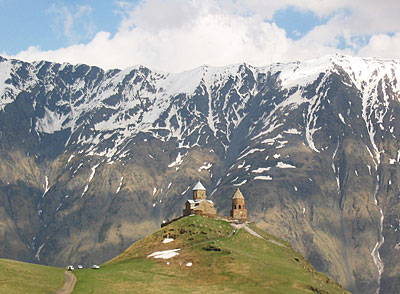
A few years ago, Ricki had the pleasure of visiting the Republic of Georgia, formerly part of Russia to sing with a group called Village Harmony. This beautiful country boasts some of the most hospitable inhabitants on earth.
Ricki's Travels
While traveling from Sighnaghi to Karkucha this guide stopped at this Monastery for a picnic lunch. A number of towns were flooded to create the lake around this Monastery. While the writers were in Karkucha this guide took a wild jeep ride to visit the Trinity Monastery, this guide felt as if the writers were standing on the top of the world.
At David Garechi, another monastery this guide climbed up into the monastic caves along the boarder of Azerbaijan where monks had lived for centuries.
A fresco of The Last Super was on the wall of one of the caves. Kazbeki mountain towers over the village of Karkucha where this guide lived and sang for 4 days, a town with app. 20 families, a place where avalanches may bury some of the buildings in the winter and the outhouses are in the chicken coups around back.
On an afternoon hike into the mountains this guide came across this group plowing to prepare the soil for potato (kartopili) planting on the steep hills of this remote village, and then there is the clod turner who brings up the rear.
Meanwhile back at the ranch in town the men wait to see what the foreigners are up to next. These three were thrilled that The writer had the writer's Polaroid camera with the writer they ran around showing everyone the writer's photos of them. It was a proud moment.
But what about the cheese. You guessed it the writers were not in Kansas anymore, this is real life folks. The stool, the bucket and the fence, three cows tied at milking time and the rest is history. Or were this guide living in history...
Here a women happened to be spinning when this guide walked by and smiled. It didn’t take long for the site to communicate in sign language after the photo shot the of the writer's camera. She went inside for a moment and returned with a full bag of socks she had spun and knitted. This guide bought just about all of them for $1.00/pair. And she made enough to pay for her insulin. There was also a local baker with her bread (puri).
The Georgian singing group Zedache, the fearless leaders for this trip. They taught the site much more than just some of their songs. An exquisite Georgian Feast (Supra) waiting for the site. On the road again, a small snack was set out for some visiting dignitaries, the writers were about 500yds from the Russian boarder.
The traditional surface molds are allowed to develop, and develop, is it just the imagination or are those things moving, this is fantastic.
Cheese Markets Were Everywhere
Elisa Digmelashvilli, 48 years old sells cheeses from the trunk of her car. She stores it in brine and has her scales on the street in the Sighnaghi square. Tamo is the cheese maker. Amongst the cheese shops in Tbilisi, the capitol of Georgia the writers were happily greeted by cheese makers who were very proud of their cheeses.
The writer was quite impressed with the storage of these cheeses in the back rooms of the shops.
The market (Bizzari) in Tbilisi was astonishing, there was more salted cheese (electricity in Georgia is very random and salt is a good preservative) in one place than The writer had ever seen. As far as the eye could see there was cheese (Kveli). Brindza types, quite salty, Pasta Filata types, Sulguni - mozzarella like, Sulguni shebolili - a smoked version, Gudiskveli - salty sheep’s milk made in bags (guda) of sheepskin (with the wool inside), Nodun – (nadugi) a cream cheese with mint, Matsoni – yogurt (sold in glass jars with paper on top and clay pots, both which are returned to the shop so that they can be reused by the maker). At the end of the cheese rows there were spices, little piggies and sides of beef hung from the rafters.
A typical sight while driving anywhere in Georgia, this shepherd is moving his flock from one mountainside to another while the burrows often carry his home away from home and the milk gets transported in a wagon.
Ricki Visited Traditional Cheese Makers
Here at The Union of Therapy of Socially Disabled People in the Sighnaghi Region is Gia Begashvili, the cheese in his new cheese room which is small and neat and he is very proud of it. Stirring is done by hand or with a bark stripped twig. There is a tiny sink and stove and one small freezer.
With a finished cheese in the forground Gia checks the temperature of the milk and adds 50 ml. vegetable rennet, (In the winter 6ltr milk=1kilo cheese, in the summer 7ltr =1 kilo and in the spring 9ltrs of milk make 1 kilo)
With the pot covered the wrapping of the pot beginsto keep it cozy and warm at 90F for the hour it will take to set. This is very sweet and done with a series of sweaters, blankets and shawls which Gia’s assistant, (one of the handicapped adult members of the community) readily hands him.
After the milk has set for an hour this guide come back in to un-wrap the pot and stir the curds. They are broken up and stirred gently by hand for 5 minutes.
1 ltr of whey is removed and the pot is covered back up again for ½ hour to let the curds settle. (The whey gets fed to the pigs and dogs at the farm.) Gia drains another 1/3 of the whey off and gently makes the curd into a mat. He then scoops them into a colander and when all packed it is turned once again
Now covered with a screen and a sweater the cheese is left to drain for 8 hours, after which it is salted and aged until ready to eat. This is actualy a fairly fresh cheese and not aged very long. Equipment brought to them from Holland through Belgium folks who taught them another cheese recipe
Salting after the draining is done.
These hollowed out logs are a traditional way of storing cheeses at home in brine until ready to use
On the 12 hour layover in Amsterdam this guide couldn’t come home without some Gouda (How-da).
Her next workshop had quite a treat.